Showing posts with label cholesterol. Show all posts

Tuesday, March 5, 2013

Are Eggs Really Bad For Me? (Confused Day Tuesday)


When I was in school for dietetics, eggs were considered a healthy food but one that should only be consumed two days a week because of their cholesterol content.  And let's be honest, that wasn't too long ago....about 8 years to be precise.  Since that time things have changed.  Actually, a lot has changed.  Now all of a sudden cholesterol in food isn't really what raises our cholesterol...it's saturated fats (although for some populations at greater risk for heart disease, cholesterol should still be limited (read about Therapeutic Lifestyle Changes here)).  And these days even saturated fats are being looked at in a different light, with so many different forms having different effects on our blood lipids.  Speaking of blood lipids, a simple lipid profile provides only the basic information and doesn't provide enough detail for certain high-risk populations.  Advanced lipid profiles can tell us so much more about a person's risk (I mean, having "high cholesterol" may not be so bad anymore, as the types of LDL cholesterol are turning out to mean so much more than we ever thought).  It's confusing, even for me, a dietitian.  There is just so much information out there, and so much yet to be discovered.


Source: iStock Photo


The whole saturated fat debate will probably carry on for years (if you'd like to read more check out a couple of my past posts; Margarine vs. Butter, and Is Coconut Oil Really That Great?), but a debate that I believe is finally coming to an end is the debate about eggs.  Without fail, the question I get asked the most is, "How many eggs can I eat every week?" or "Are eggs bad for me"? I'm going to start handing out this article from the New York Times to everyone who asks this, because I sometimes feel like a broken record.

Source: iStock Photo
The eggs may not be bad, but the bacon? That's another story, for another post.
The bottom line? After pooling data from eight prospective studies, which included over 250,000 subjects, there was no evidence that eating up to an egg a day increase people's risk for heart disease or stroke (diabetes patients were the only exception, but there were too few in the study to draw any conclusions. Please read the very short article to learn more).

Now THAT is something to smile about!  Wondering what this is? Egg white and oat crepes; 4 egg whites, 1/2 cup oats, a dash of vanilla, put in a skillet and cook like a pancake. Top with syrup or fruit or Greek yogurt or all three!

But, the question still remains....how many eggs can be consumed each week before negative effects are seen?  That's still unclear, but the consensus seems to be that as long as you are eating a balanced diet, getting plenty of fruits, vegetables, whole grains, etc. and replacing some of your saturated fats with unsaturated fats, it's probably fine to do more than 1 egg a day, sometimes (but of course, listen to your doctor's orders, as some people are at greater risk for heart disease and some evidence still shows that a reduced cholesterol diet is very important for certain high-risk populations).


Nutrition Facts for eggs

My personal opinion?  Eggs are definitely high in cholesterol, but the mere 1 gram of saturated fat is pretty amazing. And check out the protein, riboflavin and vitamin E!  And then there is the choline, which is found in the egg yolk and has some positive health effects.   Ok, but what else do you notice about the label above?  I have a confession.  It wasn't until I was working with a client just two weeks ago who was trying to stick to a low-sodium diet that I realized just how much sodium eggs contained.  Can you believe I thought eggs were sodium free? Yeah, I'm so embarrassed.  That 65mg is mainly from the whites. And guess who eats egg whites all the time?? ME!


This is my egg white crepe, same as the picture above but a bit messier.  Still delicious.


So....basically here is what you should know; 
  • To go along with this month's National Nutrition Month Theme, remember, Eggs aren't a "Bad Food" (there is no such thing as a bad food, only bad food patterns, and don't you forget it!).  They are low in saturated fat, and even though they are loaded with cholesterol the research doesn't seem to show that they increase heart disease or stroke risk.
  • If you're skipping the egg yolks, you are missing about half of the protein and all of the choline in eggs.
  • If you are just eating the egg whites you need to consider the sodium content.  While the ~55 mg of sodium in 1 egg white isn't high, it can quickly add up when you make that 6 egg white omelet!
  • Eggs are delicious and health-promoting, but if you are on strict orders to reduce your cholesterol, do not eat them. Period.  

Here are some of my past egg recipes;


And with Easter right around the corner, don't forget eggs are perfect hard boiled and topped on spinach salads.....


....  and they are also perfect with peanut butter and chocolate ;)


QUESTION:  What's your favorite way to eat eggs??? 

By the way, I had a few questions about tempeh on yesterdays tempeh taco post.  I think any brand is fine, I don't really have a preference.  I look for fewer ingredients, and the non "Flavored" type (less sodium that way).  I also like it when they add whole grains because the texture becomes  "meat-like" (and I personally like that, not everyone does though).  It's fun to just experiment a bit.

Thanks for reading!

The Candid Rd
NOTE: I love comments!  But, be sure to come back to read any replies to questions or comments, as they do not go directly to your e-mail.


Friday, February 1, 2013

How Do I Make Kale Taste GOOD in a Smoothie?! (FAQ Friday)

This past summer I learned a really great secret about kale and smoothies.  I was talking to my neighbor about how I try so hard to enjoy kale in smoothies, but I can't.  Spinach blends so well and fits into smoothies like a charm, but I want to enjoy kale in smoothies too, because kale contains less oxalates (which can reduce calcium absorption) and it also may positively effect serum cholesterol levels (this is especially true for steamed kale).  I also want Nick to get some kale in his diet, but kale is impossible to hide in a smoothie because it has a slightly bitter taste that can make a good smoothie unpalatable.


So...what's the secret?? FREEZE YOUR KALE!  Yep, you read that right, freeze it.  Take a freezer bag and put a head of washed, dried, and chopped kale into the bag, and allow it to freeze for at least 10 hours.

After that you can add it to your smoothie just like normal.  I promise you it will be less bitter and slightly sweeter!  Now you can feed yourself and your loved ones kale (both young and old), and they won't taste the bitterness in their sweet fruit smoothie. And what's not to love about kale? Aside from its ability to bind bile acids and help you excrete them (along with cholesterol), it's also been shown to have some anti-carcinogenic properties, reduce chronic-inflammation, and is an excellent source of vitamins K, C, and beta carotene.

Here is your "all fruit smoothie" Nick.....Muahaha

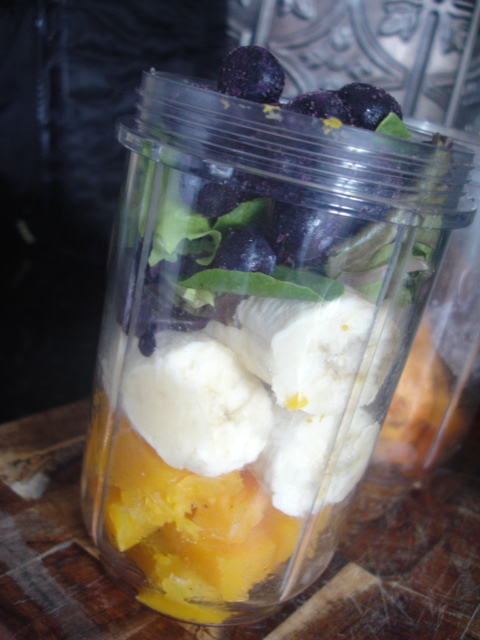
The smoothie in the picture above contains 1 large handful of frozen kale, 1/2 cup frozen blueberries, 1 banana, and enough unsweetened vanilla almond milk to cover the ingredients.


And sometimes the smoothie just looks ugly.  In that case, put it in a pretty martini glass, it helps :)

Aside from frozen kale and fresh spinach, two other vegetables I love to add to smoothies are pumpkin puree and cooked sweet potato.  Both are delicious additions to smoothies and add great texture and natural sweetness.

QUESTION:  Do you ever add veggies to your smoothies?  Have you ever tried frozen kale in your smoothies?


Next week I'll be posting a delicious citrus kale salad recipe.  So, I hope you love kale as much as I do! Until then, I'm off to work for the day then tomorrow Nick and I are off on a romantic trip up north.  Yep, we've got a heart-shaped jacuzzi in our room.  HA!  I'll be sure to post pics on INSTAGRAM (The Candid RD)!


Thanks for reading, and enjoy your weekend!

The Candid Rd
NOTE: I love comments!  But, be sure to come back to read any replies to questions or comments, as they do not go directly to your e-mail.


Saturday, August 27, 2011

Butternut Squash Ice cream and This Week's News

Here are some health and nutrition highlights from this week;


Really? The Claim: Drinking Green Tea Can Help Lower Your Cholesterol
(Like most green tea claims, this one is slightly off.)


Saturated Fat Reductions Not As Effective For Cholesterol Reduction, Study Says
(The title makes it sound like eating a low saturated fat diet isn't effective for reducing cholesterol, but in reality this study showed that a diet high in fiber, soy, plant sterols, and nuts, all of which are known to help reduce cholesterol, work better at reducing LDL cholesterol than a low saturated fat diet alone. You can read more information about this study here.)


Ban on Using Food Stamps to Buy Soda Rejected by U.S.D.A.
(What's your opinion on this issue? Personally, I think it's ridiculous that people can use food stamps to buy soda, but at the same time, is soda any worse than half of the other food/drinks that food stamps can be used to buy, such as Gatorade and Twinkies?? Not so much.)


Maggie Goes on a Diet the Sensible Way in Children's Book

(There is a new children's book out, which tells the tale of a young and overweight girl who goes on a diet. The premise sounds harmless and even helpful for some children, but the title has got to go. The word "diet" just makes me cringe, especially when used in this context.)


Antibiotic Use Has Grown Along With Obesity; Coincidence?
(Antibiotics are prescribed often, and they are killing beneficial bacteria in our gut. While this has been known for a while, new research suggests that by killing certain bacteria we may be promoting other problems such as heartburn and even obesity!)


And now for some butternut squash news! As I said last weekend, my plan is to try to come up with a different way to use butternut squash each week from now until the winter. Some of you gave me some great ideas and recipes and I've saved them all and am looking forward to doing some work in the kitchen. This week I found two new ways to use the butternut squash....


Smoothies!
(cooked butternut squash, banana, mixed greens, and frozen blueberries mixed with unsweetened vanilla almond milk and a bit of juice)


Ice Cream!

In a blender mix 2 cups half and half (chilled), 1 cup unsweetened vanilla almond milk, 3/4 cup sugar, 1.5 cups cooked/cooled butternut squash, 1 tsp nutmeg and 1 tsp pumpkin spice. Put into an ice cream maker and churn for ~20 minutes.


Oh

My

CREAMINESS!

Thanks for the idea, Meghan!!!


And, butternut squash wedding cake!!! haha, jk. This is random, but I had to share it with you. Nick and I went to a wedding last weekend and this was the cake.

I've been taking note of great cakes lately, and this one was right up my alley. The design was simple, yet elegant. Nick and I both took one look at this cake and said, "oh man, that's fondant, what a bummer", because it looked too perfect to be butter cream (and we both hate the taste of fondant). But no, it was butter cream, my friends, and it was amazing.


QUESTION: What's your favorite kind of wedding cake? Mine is a white and chocolate cake with white butter cream icing. Nothing fancy, but definitely delicious.

Wednesday, September 15, 2010

Choosing the Right Supplement for Your Heart


Do you, or anyone you know, take a supplement or consume some type of functional food for your heart? If so, this post is a must read! My favorite magazine, Today's Dietitian, printed an article in their August edition, which focused on the effectiveness and safety of heart supplements and functional food ingredients. Here are some important highlights from their article;


Plant Sterols and Stanols


- Found naturally in the walls of plants and cell membranes.

- Compete for the same binding sites as cholesterol in the GI tract, therefore they are said to inhibit excessive cholesterol absorption.

- It is recommended to consume 2 grams per day, and no more than 3 grams, in order to reduce LDL cholesterol by as much as 15%.

- While studies have shown they work for LDL reduction, no studies have shown they successfully reduce risk of cardiovascular events.

- Foods like orange juice, chocolate, and breads are poor carriers, so don't waste your money on those types of products. Dairy, mayo, dressings, and margarines are the best carriers.


Fish Oil (EPA/DHA)


- Recommended by the American Heart Association for patients with documented heart disease or high triglycerides.

- Consuming fish oil may help reduce triglycerides by 20% to 30%. Studies have also shown fish oil may help lower blood pressure, slightly increase HDL cholesterol (good cholesterol), and reduce whole body inflammation (a consequence of smoking, unhealthy eating habits, environment, strenuous exercise, etc).

- 2 to 4 grams of fish oil (EPA/DHA) per day is the typical dose for therapeutic means (4 gram doses should only be taken under the care of a physician).

- While fish oil may help lower triglycerides, there is still more research needed to determine whether it can help reduce cardiac events.

- Those without documented heart disease or high triglycerides can support good health by consuming fish twice a week or by taking a fish oil supplement with .5-1 grams EPA/DHA.

- When buying a supplement make sure they have indicated how many milligrams of EPA and DHA are in each dose. Some companies simply write, "1000 mg Fish Oil", but this is not enough information (fish oil contains more than just EPA/DHA). They should also disclose the exact amount of EPA/DHA, since this is what is most important for heart health. Unfortunately, even if they disclose this information it still may not be true, because supplements aren't regulated. Always look for the USP, GMP, or NSF symbol to know whether you're getting what you pay for.


Red Yeast Rice


- Red yeast rice is a yeast grown on fermented rice (sounds....interesting...). It is common in certain Asian foods, such as Peking Duck.

- It is sometimes referred to as "Nature's Statin" because it has been shown to reduce LDL cholesterol by 20% to 50%.

- It works by blocking a key enzyme that is necessary to make endogenous (made in the body) cholesterol. It may also contain other key ingredients such as monounsaturated fats, isoflavanoids, and sterols, which may also add to the cholesterol lowering effect.

- The amount recommended is about 1200mg/day, taken in two doses (600 mg at one time, then another 600mg later in the day).

- Be careful when buying over the counter products because many products have been shown to lack significant amounts of the ingredient. Similar to what I said above, always look for the USP, GMP, or NSF symbol on your supplements.

- Keep in mind that the side-effects of Red Yeast Rice may be very similar to statins. Talk to your doctor before starting this supplement.


Pomegranate Juice


- Claims for this product indicate it may be able to "decrease hardening of the arteries".
- The polyphenols in pomegranate juice are believed to reduce the production of plaque in arteries and may even reduce the production of cholesterol in the liver.

- Research indicates that the juice has the most significant effect on those with severe plaque and/or severe oxidative stress. Healthier individuals see insignificant effects.

- Those on blood pressure medications need to be very cautious because pomegranate juice may potentiate its effect (in other words, it may make it work even better, thus potentially causing dangerously low blood pressure).

- Be weary of some products on the market, as many appear to be of inconsistent quality (even those labeled as 100% juice). Those made with the outer layers and peel are less effective.


QUESTION: What have you done for your heart lately?


I take a fish oil pill everyday, with .5 grams of EPA/DHA combined (the dosage is 1 gram, but I only take half because I'm pretty healthy, no need to waste my money!). I also eat plenty of fiber, do 4-5 days of cardio a week, eat lots of fruits and veggies, and of course I try to relax and stay stress-free (this is the hardest one for me!).

Tuesday, August 17, 2010

Supplements; Are You Wasting Your Money?

If you were to visit me at work you would see that my desk/"office" is right in the middle of the supplement section of Giant Eagle. I really love being located right where I have access to customers looking for supplements. Many of you know how I feel about supplements, but if you don't, I will tell you that I think they can potentially play a very important role in a person's diet, but Americans know very little about the potential dangers of supplements and in my opinion we are taking way too many, and sometimes for the wrong reasons.


Nutrition Action Healthletter provided a fantastic article in their July issue, which described some popular supplements and what the data actually indicates about their reported "benefits". Here is some of what they said;


Garlic for Cholesterol?
There have been several trials testing garlic, which have let to less than impressive results. Don't count on large doses of garlic, or garlic pills to help lower your cholesterol. Enjoy garlic in your dishes as a tasty and sodium-free spice, but there are better avenues for cholesterol lowering (reduce your saturated fat intake, consume some flaxseeds, and plenty of fiber).


B Vitamins for Energy? Clearly our bodies need B-vitamins to metabolize our foods and to derive energy from our foods, but taking extra B-vitamins will do you no good. There is no credible evidence that taking B-vitamins (via a pill or other supplement) will give you extra energy. In fact, most of the supplements I've seen with > 100% DV (daily value) B-vitamins are just a waste of money, unless you eat as many calories as Michael Phelps. Even he doesn't need 3000% DV! Solution? Eat a well balanced diet and take a multivitamin if you wish. No need for >100% B-vitamins.


Want energy? Eat plenty of fruits, veggies, and whole grains.


B vitamins for your heart? This is yet another piece of advice I learned during my years in school for dietetics, but which hasn't held true since. We were taught that B-vitamins could help lower homocysteine, which is a marker of heart disease. While B-vitamins do seem to lower homocysteine, unfortunately they do not seem to lower the risk for heart disease.


Gingko for memory? Results have been mixed, but studies have more overwhelmingly showed poor evidence that gingko can improve memory. My advice? Don't waste your money! Blueberries probably provide more benefit for memory and brain health. And they taste better.


Multivitamins for immunity?
If you are well-nourished and free of disease, chances are a multivitamin will not improve your immunity. Heck, even those who are undernourished seem to obtain little benefit, if any, from taking a multivitamin. Studies are still being done in this area, but for now my best advice is to eat plenty of fruits and veggies, exercise, and get plenty of sleep (7-8 hours). These are all great ways to prevent sickness.


Biotin for hair and nails? You've probably heard this before, "Take a biotin supplement if you want your nails and hair to grow fast and stay strong!". Perhaps you even went out and bought some biotin at one time in your life. You may have noticed a difference, but chances are it was a placebo effect, "Wow! My hair really IS growing faster!...." Hmmm....I think not. The bottom line is that no credible studies have shown that biotin improves the look and speed of growth of nails or hair. My advice? Trim them both on a routine basis, find a good conditioning treatment to use on your hair (I use AVEDA), and a top coat for your nails (I use L.A. Girl Calcium. It's a clear coat and it works really well).


Question: Does any of this information shock you?! Do tell!


I'll be back on Friday. Until then, I hope everyone has a great week!

Tuesday, August 10, 2010

Eggs; The Perfect Protein For a Healthy Diet


Now that I work 40-50 hours each week I don't really spend much time in the kitchen. I do still manage to prepare tasty, healthy meals, but they're always pretty random! I really love mixing egg whites (sometimes I also add an egg yolk), baked beans, lots of veggies, and light provolone cheese.

Not the prettiest picture, but my taste buds disagree!


Have you ever had gas from eating real egg white? Or am I the only one? I buy egg whites in the container because the sulfur level is lower for some reason. The ingredients say "real egg whites" but I know they must do something to these because my GI system certainly doesn't react the same!


For Nick I have been making a lot of baked potatoes with sliced hard-boiled egg on top. Random, right? I always give him some type of vegetable too. On this particular evening he had his potato and egg with baked beans, yellow squash from our garden, and some cooked spinach.


When I was in school for dietetics, from 2001-2005, we were taught that eggs should only be consumed 1-2 times per week. Even though my college days weren't that long ago, research has come a long way since then and we now know that the once feared cholesterol in eggs actually poses less of a threat on our body's cholesterol than once thought. Research has been mixed, but as of now it's pretty clear that it is the saturated fat in foods that causes an increase in our cholesterol, not cholesterol in foods. So what does that mean for egg lovers? Eat up!


More Reason Why Eggs Are the Perfect Protein For a Healthy Diet!

- While eggs are high in cholesterol (~213 mg per egg), they are low in saturated fat (~1-3 grams) and free of trans fat. Saturated and trans fats are the fats that will increase your cholesterol.

- Eggs contain a high-quality protein source, which means the protein is more effectively absorbed and used by the body. Have you seen some cereals lately that claim to have "As much protein as an egg!?" Well that may be true, but it's not high-quality protein.

- Eggs are inexpensive, compared to most other high-quality proteins (such as meat, fish, and poultry).

- For some individuals who are more sensitive to cholesterol in foods (such as my dad's family!) eggs may increase their LDL (bad) cholesterol, but at the same time they also increase their HDL (good) cholesterol, which evens out the good:bad ratio.

- Eggs contain lutein and zeaxanthin, two carotenoids essential to the health of your eyes. They can help reduce the risk of cataracts and age-related macular degeneration.

- Eggs contain choline, which is essential for normal growth and development. Choline may also help improve memory!

- Eggs contain folate, B12, riboflavin, and vitamins A,D, and K. All of these are important components in a well-balanced diet.


QUESTION:
How do you eat your eggs?

I hope everyone had a great weekend. I'll be back with another post on Friday! By the way, if you can, stop by Melinda's blog to enter her one year blog anniversary giveaway. You may receive something special from overseas!

Thanks for reading, and have a great day!