
Happy Saturday! Is it nice weather where you are? Yesterday morning I woke up to SNOW and ICE on the ground. WHAT?? It was almost 65 degrees last weekend, and this weekend it snows? Crazy. Today is nice and sunny, but still pretty chilly.
Today I wanted to bring some attention to a comment I received from an anonymous reader yesterday, regarding my last post. In that post I reported my body fat percentage (21.6%) and claimed that I am very happy with this percentage because it puts me in the range of "healthy and fit". I then proceeded to disclose that when I was anorexic I had been 11% body fat, which was definitely not something that I was proud of ( I made reference to the fact that this is an unhealthy body fat percentage, and it's no wonder I felt like crap all the time). The comment is written in black writing, with my comments in red:
I love your blog (thanks!), but there were a few things here that frustrated me a bit. Since your are an RD I have tremendous respect & appreciation for your knowledge, but nutrition for sport & fitness varies from the standard healthy diet. (Yes, I agree, depending on what type of training you are doing). Clearly a marathon runner needs to eat differently than a football player, etc. (Well, yes, but maybe not the offensive line. They do a lot of endurance training, similar to marathon runners. The defensive line, however, would clearly have a different diet and training protocol). Maybe you didn't mean to come off this way, but how you discuss the not-so-preposterous idea of being at 40% protein suggests being closed minded. Many people operate better and have more energy with a lower carb, higher protein diet. And as you know, loosing weight would have to do with the amount of calories from protein, not just from eating more protein vs. carbs or fat. (This is correct. What I should have said was that if that trainer was to suggest that in order for me to gain more muscle, I need to consume 40% of my calories from protein, he should have also said that I need to consume more calories that I burn. You cannot build muscle simply by eating a lot of protein, you have to be eating so as to create a positive calorie balance). What bothered me the most though was your statement about your body fat %. The way you suggest that 11% is unhealthy, I believe, is sending the wrong, perhaps irresponsible, message. There is a big difference between being anorexic at 11% and being healthy at 11%, which is very possible. That is actually around what I am, and I am very healthy & energetic, and in no way excessively skinny. (If you read any respectable and reliable journal, magazine, book, or talk to any professional RD or personal trainer, they will tell you that 12% is the lowest percent of body weight for women that is considered "not risky". I have two references right here in front of me, Sports Nutrition, A Practice Manual for Professionals by Marie Dunfor, PhD, RD, and The Complete Food and Nutrition Guide by Roberta Larson Duyff, MS, RD, which clearly state that this is the case. I also took several sports nutritional classes both while in undergraduate and graduate school, where 12% was cited as the lowest possible percentage of body fat for women that is considered not risky. That being said, I do believe you can reach 11% body fat while having a healthy diet. I should not have implied that those who have an 11% body fat are obviously anorexic or have disordered eating. But I will stick to my opinion that 11% body fat is simply too low. At that percentage of body fat you are putting yourself at risk, and I would never recommend staying that low for long periods of time. Some people may remain at that low of a body fat percentage while they are competing in a body competition, but otherwise they are likely to gain some back once they are not competing. That is always suggested. Even the not so reliable magazines report that the range of healthy body fat percentage for women should not go as low as 11%. You are at risk for infertility, heart problems, and improper insulation and cushioning of your organs and bones) Thanks for your comment, I really do appreciate it. If you would like to e-mail me and talk with me more about this subject I would be glad to hear your thoughts.
Today I wanted to bring some attention to a comment I received from an anonymous reader yesterday, regarding my last post. In that post I reported my body fat percentage (21.6%) and claimed that I am very happy with this percentage because it puts me in the range of "healthy and fit". I then proceeded to disclose that when I was anorexic I had been 11% body fat, which was definitely not something that I was proud of ( I made reference to the fact that this is an unhealthy body fat percentage, and it's no wonder I felt like crap all the time). The comment is written in black writing, with my comments in red:
I love your blog (thanks!), but there were a few things here that frustrated me a bit. Since your are an RD I have tremendous respect & appreciation for your knowledge, but nutrition for sport & fitness varies from the standard healthy diet. (Yes, I agree, depending on what type of training you are doing). Clearly a marathon runner needs to eat differently than a football player, etc. (Well, yes, but maybe not the offensive line. They do a lot of endurance training, similar to marathon runners. The defensive line, however, would clearly have a different diet and training protocol). Maybe you didn't mean to come off this way, but how you discuss the not-so-preposterous idea of being at 40% protein suggests being closed minded. Many people operate better and have more energy with a lower carb, higher protein diet. And as you know, loosing weight would have to do with the amount of calories from protein, not just from eating more protein vs. carbs or fat. (This is correct. What I should have said was that if that trainer was to suggest that in order for me to gain more muscle, I need to consume 40% of my calories from protein, he should have also said that I need to consume more calories that I burn. You cannot build muscle simply by eating a lot of protein, you have to be eating so as to create a positive calorie balance). What bothered me the most though was your statement about your body fat %. The way you suggest that 11% is unhealthy, I believe, is sending the wrong, perhaps irresponsible, message. There is a big difference between being anorexic at 11% and being healthy at 11%, which is very possible. That is actually around what I am, and I am very healthy & energetic, and in no way excessively skinny. (If you read any respectable and reliable journal, magazine, book, or talk to any professional RD or personal trainer, they will tell you that 12% is the lowest percent of body weight for women that is considered "not risky". I have two references right here in front of me, Sports Nutrition, A Practice Manual for Professionals by Marie Dunfor, PhD, RD, and The Complete Food and Nutrition Guide by Roberta Larson Duyff, MS, RD, which clearly state that this is the case. I also took several sports nutritional classes both while in undergraduate and graduate school, where 12% was cited as the lowest possible percentage of body fat for women that is considered not risky. That being said, I do believe you can reach 11% body fat while having a healthy diet. I should not have implied that those who have an 11% body fat are obviously anorexic or have disordered eating. But I will stick to my opinion that 11% body fat is simply too low. At that percentage of body fat you are putting yourself at risk, and I would never recommend staying that low for long periods of time. Some people may remain at that low of a body fat percentage while they are competing in a body competition, but otherwise they are likely to gain some back once they are not competing. That is always suggested. Even the not so reliable magazines report that the range of healthy body fat percentage for women should not go as low as 11%. You are at risk for infertility, heart problems, and improper insulation and cushioning of your organs and bones) Thanks for your comment, I really do appreciate it. If you would like to e-mail me and talk with me more about this subject I would be glad to hear your thoughts.
Quick, Tasty, and Healthy Recipe #19
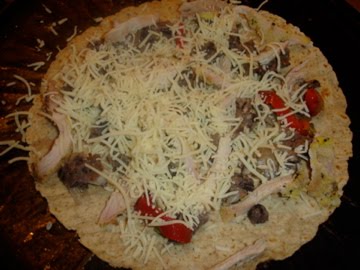
Chicken Quesadillas
Ingredients
(Serves 1)
1 whole wheat tortilla
1/4 cup black beans
3 ounces chicken
1/4 cup red and green bell pepper
1 ounce shredded American cheese
Possible Modifications
(Serves 1)
1 whole wheat tortilla
1/4 cup black beans
3 ounces chicken
1/4 cup red and green bell pepper
1 ounce shredded American cheese
Possible Modifications
- Use any type of meat/poultry/tofu you wish
- Add extra veggies
- Add extra spices
- Use different cheese
Directions

Nutrition Facts
Preheat oven to 300 degrees. Place the tortilla on a baking pan and cover the tortilla with the above ingredients (don't add too much or it won't fold properly). Fold the tortilla in half, then place in the oven for 10-15 minutes (depending on your oven and how you well done you prefer your quesadillas to be). If you want, you can add a bit more cheese on top!
Nutrition Facts

Rating: 10 out of 10 for both of us!
I used a wheat free tortilla, since I do not eat wheat.


Coming Up
Have a great weekend everyone, and thanks for reading :)
I've been so busy lately, I don't even have time to watch TV anymore! That being said, I may or may not have time to watch Jamie Oliver's Food Revolution today (we have it saved on Tivo). If I do, I will write a review, if I don't....well...you'll have to be surprised I guess!
Have a great weekend everyone, and thanks for reading :)


